Showing posts with label Science. Show all posts

Thursday, August 16, 2007

Apparently the apple fell 250 years and two contents away from the tree.

A little known school of scholars in southwest India discovered one of the founding principles of modern mathematics hundreds of years before Newton according to new research. Dr George Gheverghese Joseph from The University of Manchester says the 'Kerala School' identified the 'infinite series'- one of the basic components of calculus - in about 1350. The discovery is currently - and wrongly - attributed in books to Sir Isaac Newton and Gottfried Leibnitz at the end of the seventeenth centuries.

The team from the Universities of Manchester and Exeter reveal the Kerala School also discovered what amounted to the Pi series and used it to calculate Pi correct to 9, 10 and later 17 decimal places. And there is strong circumstantial evidence that the Indians passed on their discoveries to mathematically knowledgeable Jesuit missionaries who visited India during the fifteenth century.


Indians predate Newton 'discovery' by 250 years. [Physorg]

Thursday, August 9, 2007

I never came upon any of my discoveries through the process of rational thinking. - Einstein

Of all the objects in the universe, the human brain is the most complex: There are as many neurons in the brain as there are stars in the Milky Way galaxy. So it is no surprise that, ­despite the glow from recent advances in the science of the brain and mind, we still find ourselves squinting in the dark somewhat. But we are at least beginning to grasp the crucial mysteries of neuroscience and starting to make headway in addressing them. Even partial answers to these 10 questions could restructure our understanding of the roughly three-pound mass of gray and white matter that defines who we are.


Ten Unsolved Mysteries of the Brain. [Discover Magazine]

Saturday, August 4, 2007

Spinach will keep you healthy and get you the goils, but the huge forearms are entirely up to you.

Simplify your life and boost your health with these basic foods that really work. You can nibble on goji berries, whip up noni juice smoothies and stock your shelves with antioxidants. But if you're looking for what really works for optimal health and disease prevention, the best approach is to focus on foods that are rich in disease-fighting phytochemicals.

"Basic foods that have proven health benefits are what we want to emphasize." says Steven Pratt, MD, author of SuperFoods Healthstyle. "For example, blueberries, broccoli and tomatoes have a large number of peer-reviewed published studies substantiating their health benifits. These foods are readily available, inexpensive and have other benefits, such as high fiber content. And they've been used for years, with m no drawbacks, side effects or toxicity; you're never going to see a headline that blueberries are bad for you."

  • Broccoli
  • Pumpkin
  • Blueberries
  • Fish
  • Spinach
  • Tomatos


Six Superfoods that Prevent Disease. [Red Orbit]

Tuesday, July 31, 2007

I, for one, would like to welcome our hoop jumping, tuna munching overlords.

At the Institute for Marine Mammal Studies in Mississippi, Kelly the dolphin has quite a reputation. All the institute’s dolphins are trained to hold onto any litter that falls into their pools until they see a trainer, when they can trade the litter for fish. Kelly took this task one step further. When people drop paper into the water she hides it under a rock at the bottom of the pool. The next time a trainer passes, she tears off a piece of paper to give to the trainer. After a fish-reward, she goes back down, tears off another piece of paper, gets another fish, and so on. This behaviour is particularly interesting because it suggests that Kelly has a sense of the future and delays gratification.

At Kewalo Basin Marine Laboratory in Hawaii, Lou Herman and his team have developed a sign language to communicate with the dolphins, and the results are remarkable. Not only do the dolphins understand the meaning of individual words, they also understand the significance of word order in a sentence. For example, they generally responded correctly straight away to “touch the Frisbee with your tail and then jump over it.” This has the characteristics of true under- standing, not rigid training.


Just how bloody smart are these dolphins anyway? [Environmental Graffiti]

Wet = Rain, Bright = Sunny, Windy = High probability of the Marilyn Monroe effect.

My favorite part of the entire page is the warning at the end:

Don't risk your life or well-being based on these indicators and proverbs. Predicting the weather in this manner is not an exact science.

Considering even Meteorologists are usually batting only about .200, I'd have to agree. That said, the advice isn't totally useless. Though some are better than others.
  • Check the grass for dew at sunrise.
  • Remember the rhyme: "Red sky at night, sailor's delight; Red sky at morning, sailors take warning."
  • Look for a rainbow in the west.
  • Take a deep breath. Close your eyes and smell the air.
  • Watch the clouds.
  • Observe animals. They are more likely to react to changes in air pressure than we are.
  • Look at the moon during the night.

How to predict the weather without a forecast. [Wikihow]

Monday, July 30, 2007

SIM Planet: Coming Soon to a console near you.

The late Carl Sagan once asked this question, “What does it mean for a civilization to be a million years old? We have had radio telescopes and spaceships for a few decades; our technical civilization is a few hundred years old... an advanced civilization millions of years old is as much beyond us as we are beyond a bush baby or a macaque.”

Although any conjecture about such advanced civilizations is a matter of sheer speculation, one can still use the laws of physics to place upper and lower limits on these civilizations. In particular, now that the laws of quantum field theory, general relativity, thermodynamics, etc. are fairly well-established, physics can impose broad physical bounds which constrain the parameters of these civilizations.

This question is no longer a matter of idle speculation. Soon, humanity may face an existential shock as the current list of a dozen Jupiter-sized extra-solar planets swells to hundreds of earth-sized planets, almost identical twins of our celestial homeland. This may usher in a new era in our relationship with the universe: we will never see the night sky in the same way ever again, realizing that scientists may eventually compile an encyclopedia identifying the precise co-ordinates of perhaps hundreds of earth-like planets.

Today, every few weeks brings news of a new Jupiter-sized extra-solar planet being discovered, the latest being about 15 light years away orbiting around the star Gliese 876. The most spectacular of these findings was photographed by the Hubble Space Telescope, which captured breathtaking photos of a planet 450 light years away being sling-shot into space by a double-star system.

But the best is yet to come. Early in the next decade, scientists will launch a new kind of telescope, the interferome try space telescope, which uses the interference of light beams to enhance the resolving power of telescopes.


The Physics of Extraterrestrial Civilizations. [mkaku.org]

One box, two box, red box, green box that could potentially eliminate carbon emissions.

The world's richest corporations and finest minds spend billions trying to solve the problem of carbon emissions, but three fishing buddies in North Wales believe they have cracked it. They have developed a box which they say can be fixed underneath a car in place of the exhaust to trap the greenhouse gases blamed for global warming -- including carbon dioxide and nitrous oxide -- and emit mostly water vapor.

The captured gases can be processed to create a biofuel using genetically modified algae. Dubbed "Greenbox", the technology developed by organic chemist Derek Palmer and engineers Ian Houston and John Jones could, they say, be used for cars, buses, lorries and eventually buildings and heavy industry, including power plants.


A box to make biofuel from car fumes. [Reuters]

How do you know if you have a tough mosquito? You slap him and he slaps you back.

You're flipping burgers for the neighborhood barbecue, and the mosquitoes have already begun their feast -- on you. As you swat madly at the pests, you notice other folks seem completely unfazed. Could it be that mosquitoes prefer dining on some humans over others? This may clear up the mystery.

It's true. Mosquitoes do exhibit blood-sucking preferences, say the experts. "One in 10 people are highly attractive to mosquitoes," reports Jerry Butler, PhD, professor emeritus at the University of Florida. Incidentally, it's not dinner they're sucking out of you. Female mosquitoes -- males do not bite people -- need human blood to develop fertile eggs. And apparently, not just anyone's.

"People with high concentrations of steroids or cholesterol on their skin surface attract mosquitoes," Butler tells WebMD. That doesn't necessarily mean that mosquitoes prey on people with higher overall levels of cholesterol, Butler explains. These people simply may be more efficient at processing cholesterol, the byproducts of which remain on the skin's surface.

Mosquitoes also target people who produce excess amounts of certain acids, such as uric acid, explains entomologist John Edman, PhD, spokesman for the Entomological Society of America. These substances can trigger mosquitoes' sense of smell, luring them to land on unsuspecting victims.

"Any type of carbon dioxide is attractive, even over a long distance," Conlon says. Larger people tend to give off more carbon dioxide, which is why mosquitoes typically prefer munching on adults to small children. Pregnant women are also at increased risk, as they produce a greater-than-normal amount of exhaled carbon dioxide. Movement and heat also attract mosquitoes.


Are You A Mosquito Magnet? [WebMD]

If you have an overwhelming desire to stare at the sun, now would be the best time to do so.

While sidewalks crackle in the summer heat, NASA scientists are keeping a close eye on the sun. It is almost spotless, a sign that the Sun may have reached solar minimum. Scientists are now watching for the first spot of the new solar cycle to appear.

The 11 year long solar cycle is marked by two extremes, solar minimum and solar maximum. Solar minimum is the period of least solar activity in the solar cycle of the sun. During this time sunspot and solar flare activity diminishes, and often does not occur for days at a time.
When spots begin to appear on the sun once again, scientists know that the sun is heading into a new season of extreme solar activity. At the cycle's peak, solar maximum, the sun is continually peppered with spots, solar flares erupt, and the sun hurls billion-ton clouds of electrified gas into space.


The Sun Loses Its Spots. [NASA]

Tuesday, July 17, 2007

The question you're asking yourself right now is why aren't 'stupid people' on the list.

One would do well to point out that for as amazing as the human body is, that this finely tunned machine of thousands of large and small and tiny parts that function together to allow one of the most complex of all creatures to walk the Earth has more than a few spare parts that really aren't necessary. These vestigial items, for the most part, are more trouble than they're worth. That said, some are remnants of some very cool functions from our less evolved days. Just a few of them are listed below.

  • Appendix
  • Paranasal Sinuses
  • Coccyx
  • Third Eyelid
  • Palmaris Muscle
  • Wisdom Teeth
  • Body Hair
  • Thirteenth Rib...

What Evolution Left Behind on Humans. [decimation.com]

Tuesday, July 10, 2007

*Yawn*

Rather than being a precursor to sleep, yawning is designed to keep us awake, say US researchers. But why does seeing someone else yawn make you to do the same?

Yawning is an involuntary action that everyone does. We start before we are born and most creatures on the planet do it - even snakes and fish. New research suggests rather than being a precursor to sleep, the purpose of yawning is to cool the brain so it operates more efficiently and keeps you awake. The theory could explain a puzzling question about subconscious human behaviour - why many of us yawn when we see or hear another person doing it, or even read about it or even just think about it?


The brain cooling theory says that when we contagiously yawn we are participating in an ancient, hardwired ritual that evolved to help groups stay alert and detect danger.

Why is yawning contagious? [BBC]

Thursday, July 5, 2007

Norman Bates framed by shower curtain?

To attack the shower curtain problem, I used software designed by Fluent Inc., a New Hampshire-based software company that contracted my consulting firm, Convergent Thinking LLC, to add advanced spray models to their software. The simulation took advantage of the fruits of this project. I was able to include the effects of the drops breaking up. Even more important, the new spray models captured the distortion of the droplets, which tends to increase their aerodynamic drag. This drag is the force between the air and the water that imparts motion to the air and slows the droplets.

To do the calculation, I drafted a model of a typical shower and divided the shower area into 50,000 minuscule cells. The tub, the showerhead, the curtain rod and the room outside of the shower were all included. I ran the modified Fluent software for two weeks on my home computer in the evening and on weekends (when my wife wasn't using the computer). The simulation revealed 30 seconds of actual shower time.

When the simulation was complete, it showed that the spray drove a vortex. The center of this vortex¿much like the center of a cyclone¿is a low-pressure region. This low-pressure region is what pulls the shower curtain in. The vortex rotates around an axis that is perpendicular to the shower curtain. It is a bit like a sideways dust devil. But unlike a dust devil, this vortex doesn't die out because it is driven continuously by the shower.

Why does the shower curtain move towards the water? [Scientific American]

Sunday, July 1, 2007

Love and kisses. - Zaphod

You may or may not need to be something of a science buff or outright geek to appreciate this Java applet. Here you get the opportunity to play Flying Spaghetti Monster and create a mini solar system. You can have a single star (sun) or two and have as many planets as you like orbiting around them. Warning, don't become particularly attached to any single world as quite often you'll find that some are bound to smash together and obliterate all the denizens worshiping you.

Plant simulation. [Dan Ball]

This goes against everything we've ever learned, but the trick is NOT to focus on her.

We're dedicated to bringing you the best of the internet without the porn. We're not prudes, we're just trying to prove a point. We appreciate the form of the human body as much as the next person who is honest with themselves, so trust us when we say that we're not compromising our principles in this instance. This is more than just a silhouette of a woman who is in excellent shape and has been blessed by God, it is fascinating example of the tricks our mind can pull on us...

We were initially skeptical that this was a hoax, till we figured out the "trick" to make it work consistently well. We recommend reading the text (use the link below to view the image) and using your peripheral vision to view the image. Then close your eyes for a few seconds and the image will change. We can't promise this will work 100% of the time, but it worked best for us using this technique.

Spinning sillhouette optical illusion. [moillusions.com]

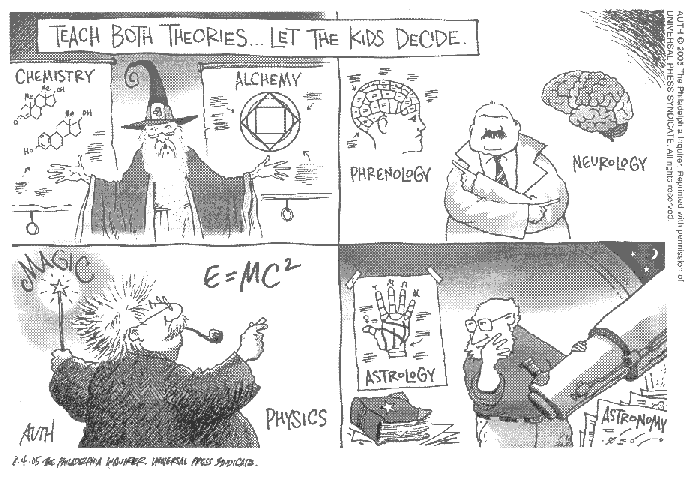
Teach both theories...Let the kids decide.

Teach both theories... [Free Forum]

Saturday, June 16, 2007

Marvin the Martian does an uncanny impression of Gene Kelly, then claims planet in the name of Mars.

Since 1991, planetary scientists have floated the idea that Mars once harbored vast oceans that covered roughly one-third of the planet. Two long shore-like lips of rock in the planet's northern hemisphere were thought to be the best evidence, but experts argued that they were too "hilly" to describe the smooth edges of ancient oceans.

The view just changed dramatically with a surprisingly simple breakthrough. The once-flat shorelines were disfigured by a massive toppling over of the planet, scientists announced today. The warping of the Martian rock has hidden clear evidence of the oceans, which in any case have been gone for at least 2 billion years.


"This really confirms that there was an ocean on Mars," said Mark Richards, a planetary scientist at the University of California at Berkeley and co-author of the study, which is detailed in the
June 14 issue of the journal Nature (registration required - editor's summary).

Mars had large oceans. [Yahoo!, Nature, New Scientist Space]

But have they ever tested the aero dynmaic properties of the L and Q formations? Those birdbrains could be missing out.

Most of us have probably seen large groups of migrating birds like geese or ducks flying in formation. These large groups of birds are particularly common in late autumn and early winter when birds migrate from their summer habitat in Canada to the warmer climate of the southern United States. Such groups of birds will typically fly in a large "V" shape with one bird in the lead and others trailing behind in two lines.

Scientists who have studied formation flight believe that birds fly in this way for two reasons. The first reason is that the shape of the formation reduces the drag force that each bird experiences compared to if it were flying alone. This decrease in drag occurs thanks to the formation of wingtip vortices described in previous articles.

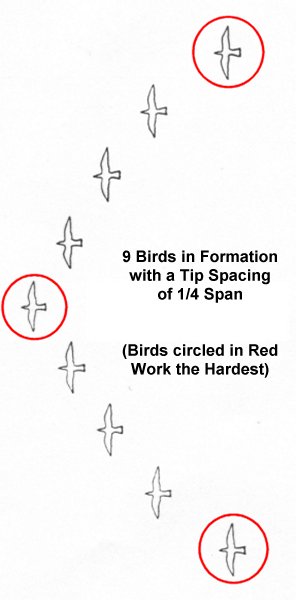
The majority of the benefit goes to the birds further aft, but the front bird does still gain some reduction in drag. The presence of the two birds flanking the leader helps to dissipate the downwash off the lead bird's wingtips and reduces the induced drag this bird experiences. These two flanking birds also benefit from a similar reduction in drag if outboard birds flank them as well. In other words, the birds in the middle of each of the lines forming the V are in the best position. These birds benefit from the upwash off the lead birds as well as off the trailing birds. This additional bonus means that birds in the middle experience less drag than either the lead bird or the bird at the end of each line.

Even though the V formation benefits all of the birds, the bird in the lead position has to work the hardest. When this bird tires, it will drop out of the lead position and fall further back into one of the lines of the V. Another bird from further back will rapidly move forward to take the leading position and maintain the formation. The two birds in the furthest trailing positions also tire more rapidly than those in the middle, so these positions are also rotated frequently to spread the most fatiguing locations throughout the flock. This cyclical rearrangement gives all birds the responsibility of being the leader as well as a chance to enjoy the maximum benefits of being in the middle of the formation. This sense of teamwork comes naturally since even the youngest members of the flock rapidly realize that it takes less work to fly in a V formation than it does to fly alone.

Why do birds fly in a v-formation? [Aerospaceweb.org]

Thursday, May 17, 2007

Apparently God has a well stocked humidor.

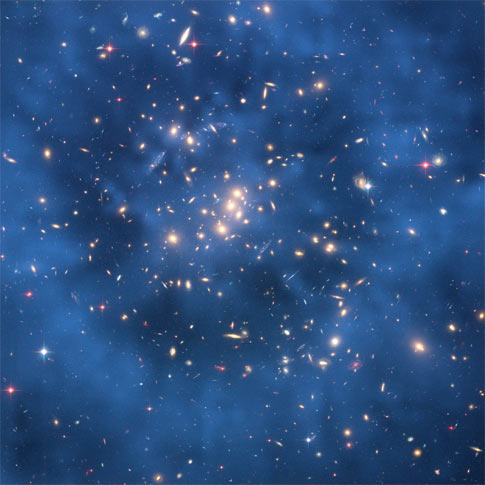
Einstein postulated that gravity from matter bends space, like a bowling ball on a bed bends the mattress. Light will follow that bend in space the same way a marble rolled across the bed will curve from the bowling ball’s dip. If there is some massive object out there in space, and some galaxy beyond it, the light from the more distant galaxy will bend as it passes by the intervening material. We see that as a distortion in the shape of the galaxy. This is called gravitational lensing, and can be used to map out the location of dark matter. So even though we cannot see DM directly, we can see its effects.

This image is of the galaxy cluster CL0024+1652 (higher resolution version), a galactic city located a whopping 5 billion light years away. That means the light we see from this cluster left it five billion years ago, so we’re seeing this structure as it was when the Universe was just 2/3 its present age. Almost every small object in that image is a galaxy, and all of them are held sway by the cluster’s gravity, orbiting the center like bees flying around a beehive.

It has long been thought that every large object in the Universe is surrounded by a halo of dark matter — unseen, mysterious, yet profoundly influential in the life of normal matter. Dark matter (or just DM for short) gives off no light, and does not interact with normal matter directly– a cloud of it could pass right through you and you’d never know. But, like regular old matter, it has gravity, and that can betray its presence.

Hubble finds dark matter 'smoke ring'. (Bad Astronomy)

Tuesday, May 15, 2007

Be sure and stop by the gift shop as you leave. Thank you for visiting Death Valley.

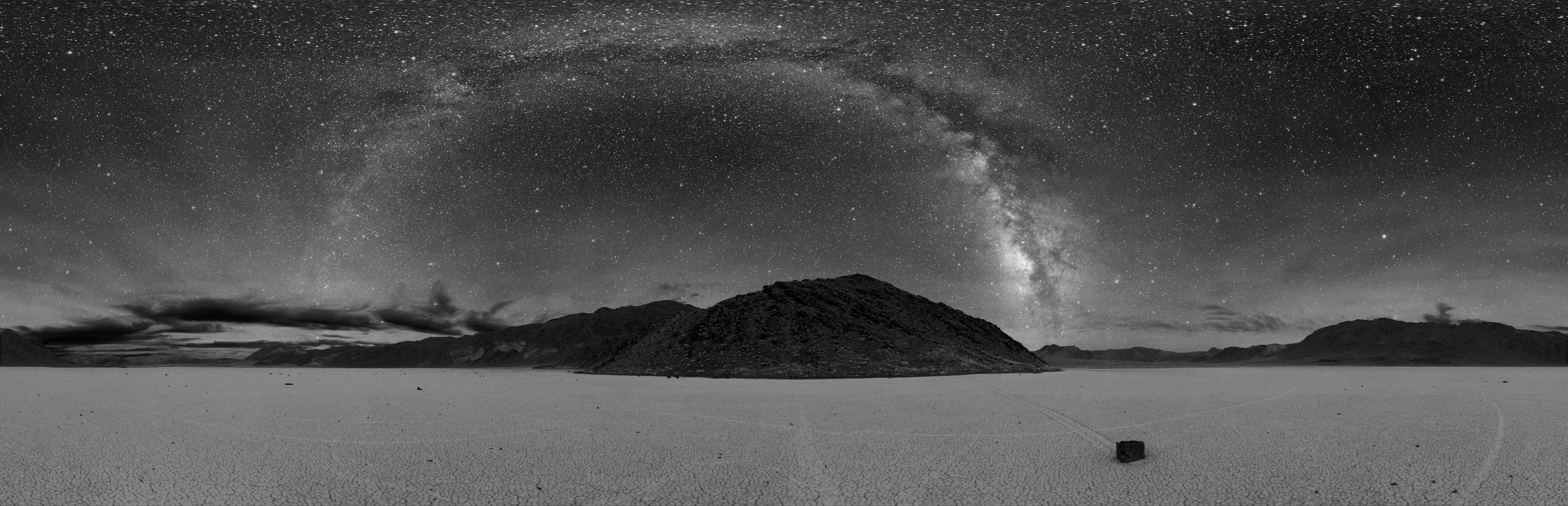
This eerie glow over Death Valley is in danger. Scrolling right will show a spectacular view from one of the darkest places left in the continental United States: Death Valley, CA. The 360-degree full-sky panorama is a composite of 30 images taken two years ago in Racetrack Playa.

The image has been digitally processed and increasingly stretched at high altitudes to make it rectangular. In the foreground on the image right is an
unusually placed rock that was pushed by high winds onto Racetrack Playa after a slick rain. In the background is a majestic night sky, featuring thousands of stars and many constellations.

The arch across the middle is the central band of our Milky Way Galaxy.
Light pollution is threatening dark skies like this all across the US, and therefore the International Dark-Sky Association and the US National Parks Service are suggesting methods that can protect them.

A dark sky over Death Valley. (NASA)

Friday, May 11, 2007

Cats love to play with String Theory.

Not everyone finds Quantum Theory to be fascinating. Fewer still can explain it; and a minute percentage of those have both a blog and a sense of humor. Chad Orzel, author of Uncertain Principles, is a contributing member of this minority who has taken the time to break down and explain Quantum Theory to his dog...who can talk.

I'm sitting at the computer typing, when the dog bumps up against my legs. I look down, and she's sniffing the floor around my feet intently.
"What are you doing down there?"
"I'm looking for steak!" she says, wagging her tail hopefully.
"I'm pretty certain that there's no steak down there," I say. "I've never eaten steak at the computer, and I've certainly never dropped any on the floor."
"You did in some universe," she says, still sniffing.
I sigh. "I'm going to move the quantum physics books to a higher shelf, so you can't reach them."
"It won't matter. I've got Wikipedia."
"All right, what ridiculous theory has your silly little doggy brain come up with?"
"Well, it's possible that you would eat steak at the computer, yes?"
"I do eat steak, yes, and I sometimes eat at the computer, so sure."
"And if you were to eat steak at the computer, you'd probably drop some on the floor."
"I don't know about that..."
"Dude, I've seen you eat." Yes, the dog calls me "dude." There may be obedience classes in her future.
"All right, we'll allow the possibility."
"Therefore, it's possible that you dropped steak on the floor. And according to Everett's Many Worlds Interpretation of quantum mechanics, that means that you did drop steak on the floor. Which means I just need to find it."

Many Worlds. Many Treats. (scienceblogs.com)